
Everything your firm needs. One workspace.
Advisd organizes your entire workflow around the household — the way advisors actually think about their clients. Every capability lives in one unified view, connected by one data layer.
Your Daily Workspace
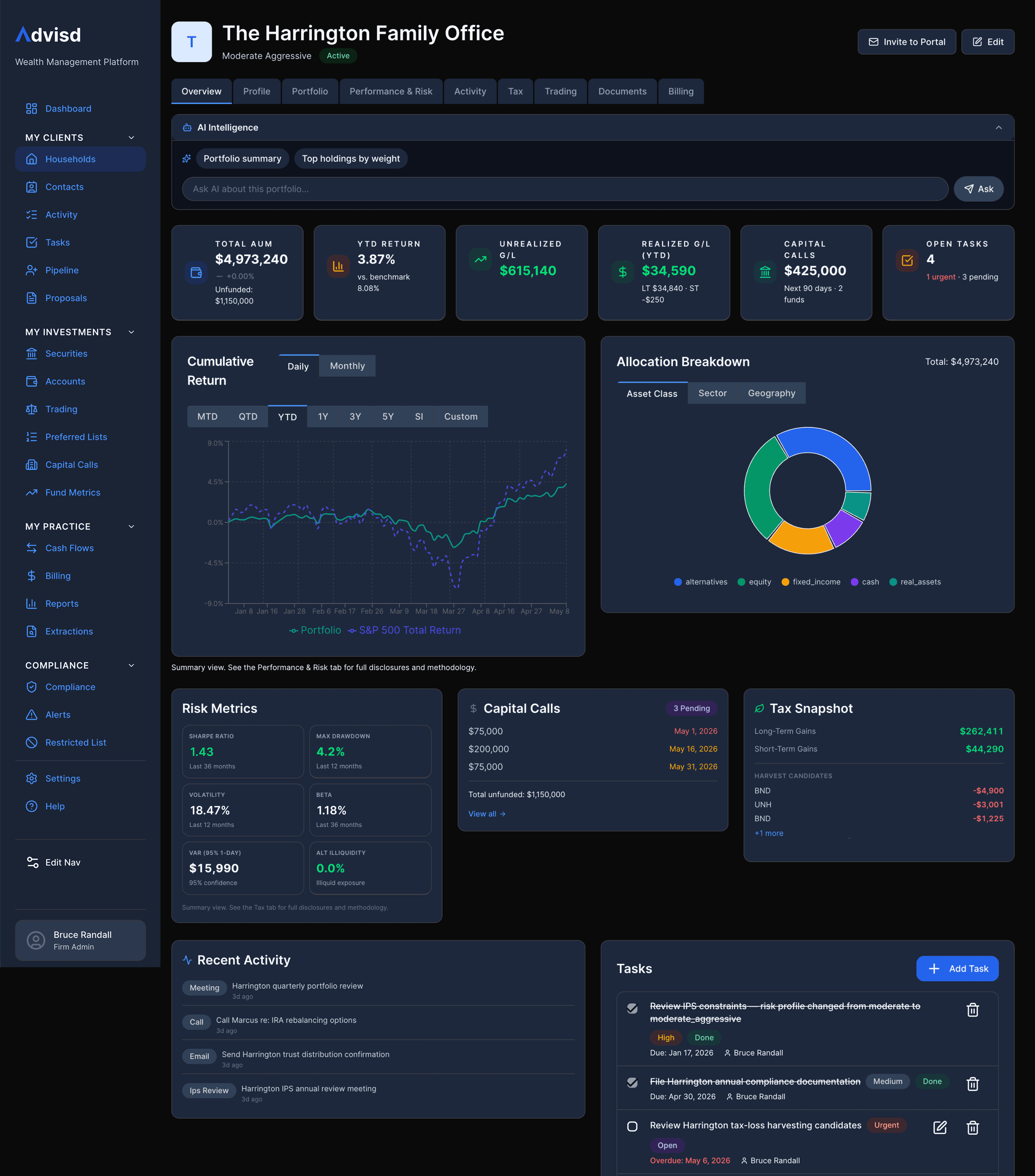
The household detail view is the center of Advisd. When you open a client household, you see tabs covering every aspect of that relationship:Overview, Profile, Portfolio, Performance & Risk, Activity, Tax, Timeline, Trading, Documents, and Billing.
No tab sends you to another application. No tab requires a separate login. Every tab shares the same data, so when you update a position, performance recalculates. When you approve a trade, the audit trail updates. When billing runs, the fee data is already there.
This is what it means to have a unified platform — not a dashboard that links to other tools, but a single application where every workflow connects.
Portfolio Management
Track every account across custodians — Schwab, Fidelity, Pershing, Interactive Brokers — with positions, cost basis, unrealized gain/loss, and full transaction history. The security master supports 17 security types spanning equities, fixed income, mutual funds, ETFs, options, and alternatives.
Import positions and transactions via CSV or Excel. The automated valuation engine handles daily price updates, accrued interest calculation for bonds (30/360 and Actual/Actual day count conventions), and stock split adjustments that preserve cost basis across tax lots.
Tax lot tracking supports FIFO, LIFO, specific lot identification, and average cost methods per IRS Publication 550. Every lot carries its acquisition date, cost, and holding period for accurate short-term vs. long-term classification.
Alternatives & Private Markets
Capital calls, fund commitments, NAV tracking, distributions, and fund performance metrics are built into the core platform. Track the full fund lifecycle from initial commitment through capital calls, distributions, and eventual liquidation.
Each fund carries its own IRR (since inception), TVPI, DPI, and unfunded commitment balance. NAV history supports multiple sources — manual entry, GP statements, estimates, and custodian feeds. Distributions are categorized by type: return of capital, income, and capital gains.
The unified portfolio view blends traditional positions with alternative fund NAVs in a single allocation analysis, a single drift calculation, and a single performance report. No separate module, no third-party integration.
Fee Billing
Advisd automates advisory fee calculation from schedule setup through invoice collection. Define fee schedules with tiered AUM rates (breakpoint-based), flat fees, hourly rates, or blended structures. Assign schedules to households with effective dates and versioning — when you change a fee schedule, the history is preserved.
The billing engine handles household-level aggregation across multiple custodian accounts and related household grouping for breakpoint calculations. Mid-period events — account openings, closings, fee schedule changes — trigger automated proration using a formal five-step pipeline.
The billing workflow enforces segregation of duties: Calculate → Review → Approve → Process, with the requirement that the approver cannot be the person who initiated the run. Fee adjustments require dual-control approval. Every step writes to the immutable audit trail.
Trading & Rebalancing
Build model portfolios at the asset class, sector, security, or hybrid level. The drift analysis engine continuously evaluates each household's actual allocation against its assigned model, using configurable absolute and relative thresholds.
When drift exceeds thresholds, Advisd generates proposed trades that respect minimum trade sizes, cash reserve requirements, and tax-lot optimization. The tax-aware lot selection engine supports MinTax (minimize tax impact), HIFO, FIFO, and specific lot identification. Wash sale detection scans across all household accounts and flags potential violations.
Proposed trades move through a formal approval workflow — Draft → Submitted → Under Review → Approved → Executing → Completed — with segregation of duties enforced between the submitter and the approver. Approved trades export directly in Schwab, Fidelity, or generic CSV format for custodian execution.
Performance Reporting
Calculate time-weighted returns (TWR) using both daily and Modified Dietz methods — TWR measures advisor investment skill by removing the impact of client cash flows. Calculate money-weighted returns (MWRR/IRR) using a Newton-Raphson iterative solver — MWRR reflects the client's actual investment experience including the timing of their deposits and withdrawals.
Compare performance against benchmarks with excess return and tracking error. Standard reporting periods cover MTD, QTD, YTD, 1-year, 3-year, 5-year, 10-year, and since inception. View performance gross or net of advisory fees. Cumulative return charts overlay portfolio performance against benchmark indices.
AI Intelligence
Every household view includes an embedded AI query bar. Type a question about a client's portfolio in plain English and get an answer grounded in that household's actual data — positions, performance, allocations, alternatives, tax lots, billing, and account structure.
The AI assembles relevant context for each question, generates computed summaries (liquidity rollups, allocation breakdowns, cross-references), and returns answers that cite specific data points rather than generic information. Advisors get full analytical depth; clients get a simplified, factual version through the portal.
Every query is logged for compliance. Responses include mandatory disclaimers. The system is designed to answer questions about what is — never to recommend what should be.
Client Portal
Your clients access their own secure portal at your firm's branded subdomain. They see read-only views of their portfolios, performance, alternatives, accounts, billing, and documents — with net-of-fee performance and SEC Marketing Rule disclosures displayed automatically.
Clients get their own AI query bar with guardrails appropriate for a non-advisory audience. They can ask factual questions about their portfolio and get data-grounded answers — no investment recommendations, no advisory content, mandatory disclaimers on every response.
The portal is branded with your firm's logo, colors, and compliance disclaimers. PII is never exposed — client views exclude SSN, Tax ID, and other restricted information entirely.
Compliance Infrastructure
Compliance in Advisd is architecture, not a feature checkbox. Regulated financial workflows write to an immutable, append-only audit trail that ordinary application and administrator workflows cannot update or delete. Configuration changes require a documented reason. PII is encrypted withAES-256-GCM at the column level, and every decryption operation is logged.
The permission system enforces 142 granular permission keys across 10 default roles, with contextual rules that limit access based on household assignments.
4251 automated compliance checks verify the infrastructure continuously, covering audit triggers, hard-delete prevention, retention enforcement, PII encryption, and permission enforcement.
Household CRM
Advisd's CRM is built around households — because that's how advisors manage relationships. Contacts belong to households with defined roles (primary, spouse, trustee, beneficiary, POA). Each household carries its suitability profile, risk tolerance, investment objectives, and time horizon.
Track activities with RIA-specific types: compliance reviews, annual reviews, trade approvals, portfolio reviews, and client meetings. The opportunity pipeline tracks prospects from initial discovery through proposal, onboarding, and activation.